




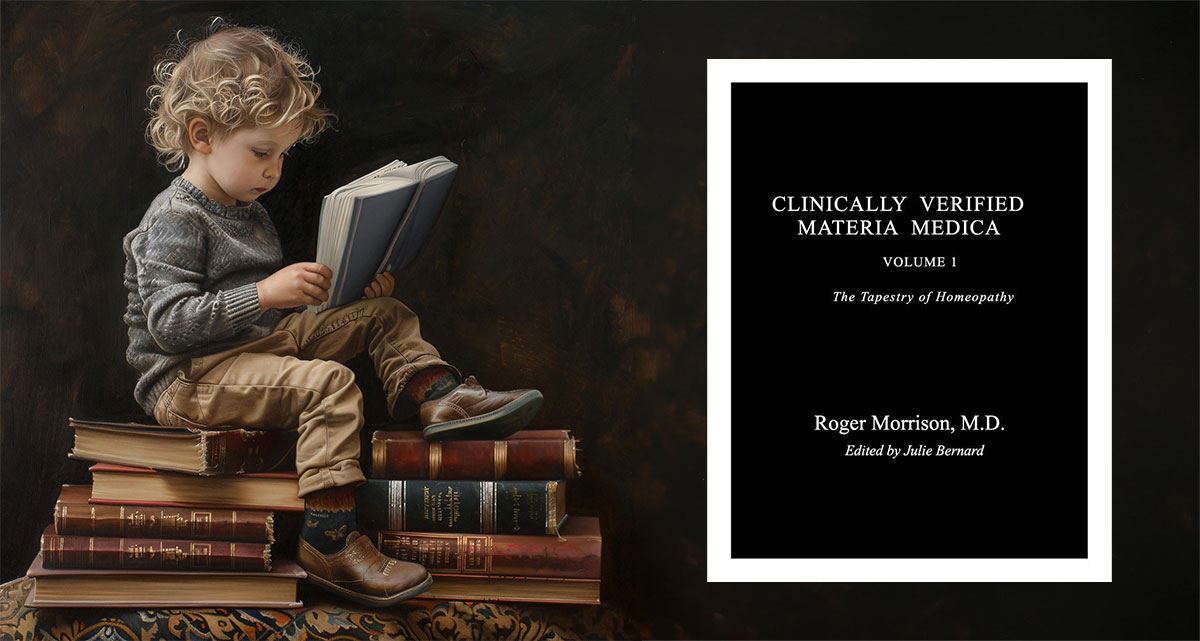
ROGER MORRISON : „Clinically Verified Materia Medica: Tapestry of Homeopathy (Volume 1)", Grass Valley 2025, 843 pages, Hardcover, Hahnemann Clinic Publishing,140$, in Europe via Emryss 138€
In 2010, Roger Morrison initially only wanted to revise his "Desktop Guide to Keynotes and Confirmatory Symptoms’. Almost twenty years after its publication, numerous new provings and, above all, new insights gained through the sensation method, work with remedy groups and various concepts on the systematics of materia medica an update of this highly successful reference work became necessary.
One of his sources for revising the remedy profiles was cured cases. In addition to his own clinical experience, he had access to a vast pool of almost 10,000 cases that his wife Nancy Herrick had collected from journals and books, seminars and colleagues over many years – all cured and solid cases, analyzed by different authors with different approaches, mainly cured by one remedy alone. His source was thus the entire homeopathic community.
The cases are the remedy itself
While it played only a minor role at the beginning of his work, it became increasingly important over time. As the study of cured cases absorbed him more and more, he realised that he was sitting on a gold mine of information. He was struck by the startling congruence of statements made by patients who required the same medicine. In case reports by completely independent authors, patients used the exact same words to describe themselves and their pathology.
One day he asked himself: "What if these cured cases are not just meant to assist in my writing about this remedy, what if they are more important than anything I am writing? What if these cases are the remedy itself? ... I decided to let the cured cases speak for themselves - to let myself be the instrument for their silent voices". At that point the planned update turned into a completely different book than the Desktop Guide. "I had to restart the book, scrapping some years of previous effort in the process. I rewrote all of the remedy chapters from this new perspective and eventually found my new role to be more like a reporter or translator than an author".
Now the first version of a remedy picture is entirely based on the study of cured cases. Only when it is finished, Morrison checks with his most trusted sources to see if he has left any gaps. Every symptom listed in the book (except when stated otherwies) is verified and comes directly from cured cases. This also applies to findings that are the result of work with groups of remedies and new classification systems over the past decades. These are only included if they have been confirmed by cured cases. Since Morrison, as a student of Vithoulkas and Sankaran, successfully uses modern approaches in his own practice, he does not intend to exclude their new findings on materia medica. However, the effectiveness of a particular remedy for a specific symptom or theme must have been proven in practice.
Valuable classification
This commitment is reflected in the new title of the Desktop Guide: ‘Clinically Verified Materia Medica Volume 1' is a summary and analysis of over 5,000 cured cases and includes 207 remedies, for which, with a few exceptions, at least three modern cases were available. Due to the importance that Scholten's periodic table and Sankaran's schema have now acquired for practical application, almost all remedies from these classification systems have been included, even if fewer cured cases were available. Thus, clinically verified symptoms can also be found for remedies such as Baryta bromata (Rows 6/4, Stages 2/17) or Asimina (Magnolianae, Ringworm miasm), that would be sought in vain in similar compendia.. Conversely, some newer groups of remedies with which the author himself is not sufficiently familiar have not been considered. These include Lanthanides, Actinides, Matridonals and Imponderables.
The remedy chapters are divided into two sections. The first is a narrative one, sometimes very detailed, sometimes very brief, describing the personality and inner experience of the patients needing the particular remedy. This prose section reveals aspects of sensation, essence as well as the genius of the remedy. Here is an excerpt from the chapter on Baryta Bromata: "In the 5 available cases, three patients were dominated, criticized and abused by those upon whom they most depend. The other two were put in positions, where they had no one to depend upon at all and thus felt unable to face responsibilities and challenges of life and profession. All of the 5 cases suffered with fear and anxiety - even panic attacks. All but one case was troubled by obsessional thoughts... It is noteworthy, that all of the cases were prescribed on for their mental state."
When enough cases are available, children's characteristics and the compensatory as well as the failed state of the remedy are also described in separate paragraphs of the narrative section. Calcarea silicata, for example, has the following entry:"In the compensatory state, several of the patients managed difficult feelings by denial.They stated they had no feelings, no tears, no emotions whatsoever and described a "robotic" state of logic. Also, many of the cases were rather withdrawn except in the family setting - having literally no friends or contact outside of their family. In the failed state, the patients sat home unable to work or mingle."
Evidence reviewed
The second part of the chapter on remedies is a mostly traditional listing of symptoms for each remedy by body part. Morrison has supplemented the schema with his own categories: ‘Sensation language’, a heading specifically for Sensation prescribers, inccludes hand gesturese and Source references. The ‘Presentations’ category describes how the patient will behave or describe himself during the intervies. ‘Combined Symptoms’ stands for strong combinations, such as the association of uterine and cardiac symptoms in Convallaria. ‘Comparisons’ lists remedies which had actually been misprescribed by the case authors.. Each chapter concludes with the heading ‘Evidence Reviewed’ indicating the number and type of case histories and other sources used for clinical verification of the remedy presentation. For example, under Euphrasia, you'll find: ‘3 detailed modern cases, 5 modern case reports, 1 modern acute case, 24 historical cases, articles by Bob Ullman and Prof. Vithoulkas.’This entry marks the end of our enthusiasm for this extraordinary work for the time being. Euphrasia is the last remedy to be clinically verified for the first volume, and hopefully the homeopathic world will not have to wait too long for Ferrum and all the other remedies that are still to come. Roger Morrison has greatly reduced his practice to focus on the meticulous and time-consuming work on this mammoth project and hopes to complete the Volume 2 by December 2026. The third and final volume should then take another two and a half years, provided the author can continue at the same pace.“
A monumental work
The high value and special status of this innovative Materia Medica cannot be overstated. It is neither an updated edition of the tried-and-tested Desktop Guide nor simply another materia medica that repeats the same truths and mistakes, reinforcing both the good and the misleading. Rather, it represents an attempt to subject the traditional materia medica to a reality check by using cured cases, while at the same time bringing it up to date with modern homeopathy. In the narrative part of the remedy chapters, Morrison succeeds in presenting a vivid picture of the remedy, while in the second part he provides practitioners with a clinically verified desktop guide as a reference work for everyday clinical practice.
‘Since it covers all aspects of the remedy, it will be of value irrespective of one's way of practising homeopathy,’ writes Rajan Sankaran in his foreword and he continues: "It is with deep admiration and excitement that I introduce this unique work to the homeopathic community. Dr. Morrison’s dedication to advancing our understanding of remedies is truly inspiring. I know that no one else in our generation could have accomplished such a monumental work." SPECTRUM can only echo this appreciation and recommend Roger Morrison's clinically verified Materia Medica to every homeopath as the main reference work for his or her consulting room.