



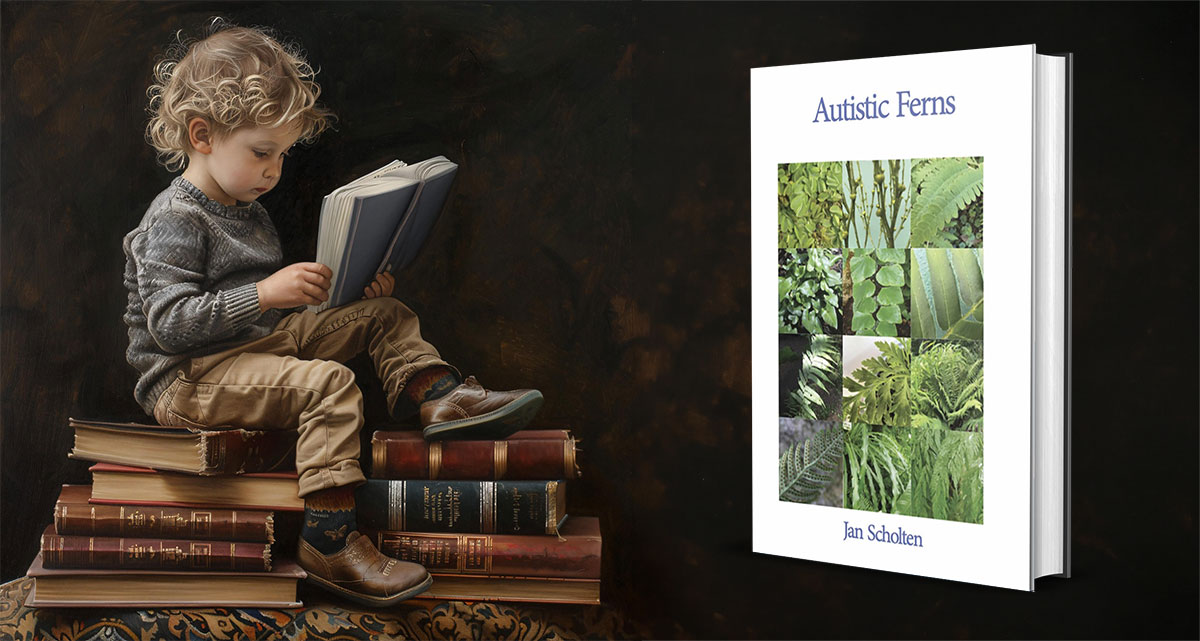
JAN SCHOLTEN : „Autistic Ferns", Utrecht 2025, 480 pages, Hardcover, Stichting Alonissos, €50.00
Do not expect a simple recommendation from me. That would not do justice to this work. The extent to which all these provings, case histories and insights expand our therapeutic options cannot be overestimated.
Helping people with autistic disorders is a task at which we homeopaths often fail. Here we read not of a few, but of many impressive improvements. The positive results are almost predictable once a suitable fern is found.
Many colleagues have understood Jan Scholten so well that they work successfully with his plant codes and have made their contribution here. As a result, the book has grown to an impressive 480 pages. No frills, no embellishments: 480 pages – what a treasure!
Jan Scholten compiles information without knowing in advance what the end result will be and ultimately finds similarities and differences. This is science as it should be.
Let us read about the Equisetaceae, for example. What we suspected is now clear and easy to recognise in patients.
The order according to the plant code, the separation of provings, case histories and remedy descriptions make the book easy to navigate. Hand marks facilitate orientation.
Autistic Ferns?
If we do not treat children whose limitations are attributed to the autism spectrum, do we then have to deal with ferns? No autism – no fern – no book? Not at all.
Ferns are not only remedies for children with autistic disorders. The title is too restrictive. Think of Lycopodium, which helps people of all ages with a variety of problems. In the case of Christella dentata, the patients in the book are between 50 and 70 years old. Nor do they appear to be autistic. What makes them need ferns? If traumas are experienced in childhood, they can be dealt with in different ways later on. When we should think of ferns becomes clear gradually as we study the book.
Patience
If the possibilities offered by this work are not immediately apparent, we can take comfort in the author's description of his journey with ferns: ‘It felt like entering a dark room and not knowing what is there (...) in three years that all became gradually better(...) it took another year(...) before I felt that finishing this book would give a balanced picture of ferns.’
In examinations and case histories, we approach the world of ferns, and it is inevitable that we will recognise ourselves in one or the other. Among our ‘personalities’, to use Jan Scholten's term, there is probably also a ‘fern personality’.
May this book be to you, as it is to me, a friend you want to get to know better and better.